5 Red Flags to Look Out for When Working With a Freight Broker
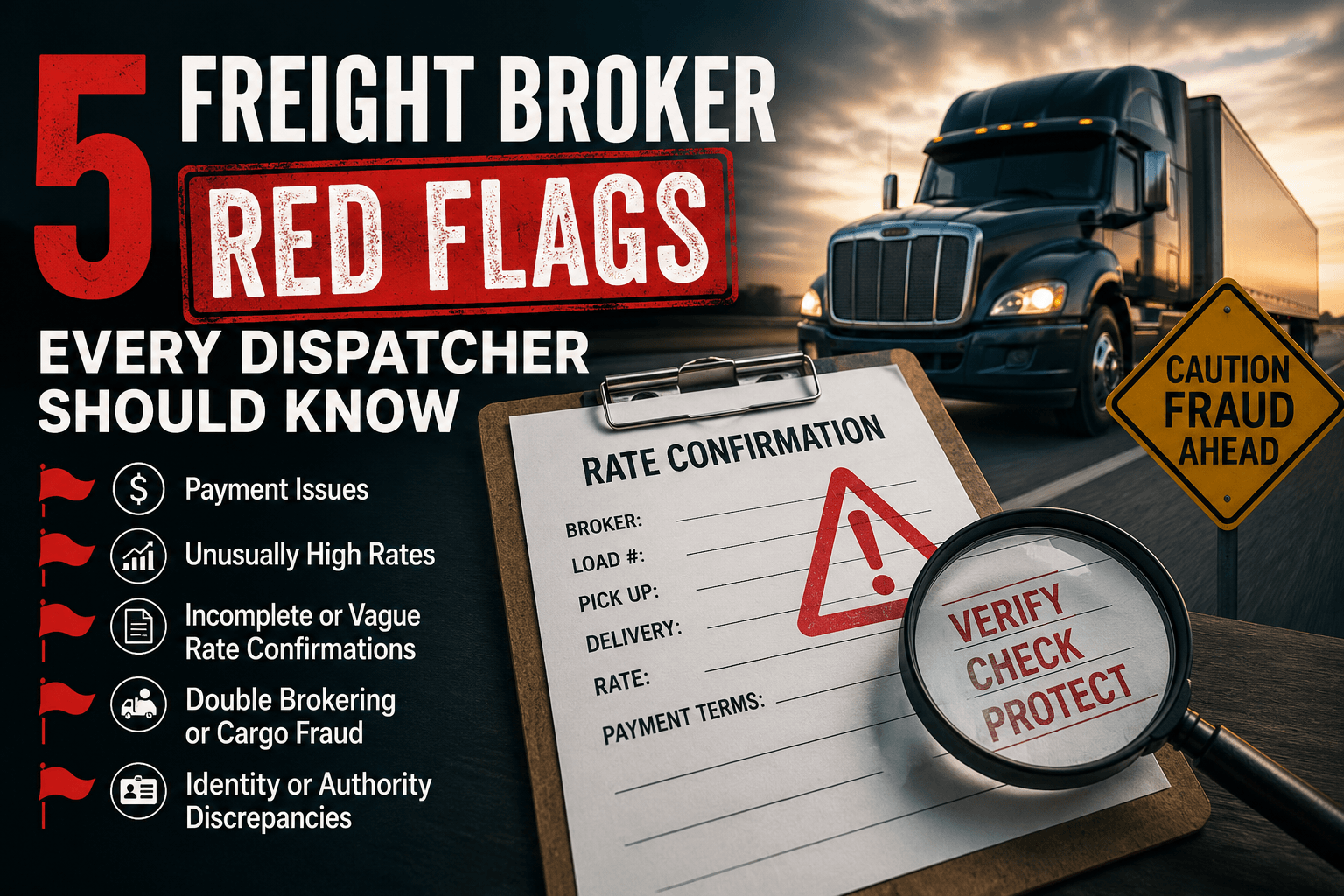
Freight brokers play an important role in trucking. A reliable broker can help carriers find consistent freight, communicate with shippers, resolve problems and keep trucks moving. However, working with the wrong broker can lead to unpaid invoices, double-brokered loads, cargo theft, detention disputes and serious damage to a carrier’s cash flow. Broker fraud and identity theft are not hypothetical problems.
Freight brokers play an important role in trucking. A reliable broker can help carriers find consistent freight, communicate with shippers, resolve problems and keep trucks moving. However, working with the wrong broker can lead to unpaid invoices, double-brokered loads, cargo theft, detention disputes and serious damage to a carrier’s cash flow.
Broker fraud and identity theft are not hypothetical problems. The Federal Motor Carrier Safety Administration warns that fraudulent actors may impersonate legitimate companies, use another company’s USDOT or MC number, or operate as a broker without proper FMCSA registration. FMCSA classifies these activities as fraud and identity theft.
A red flag does not automatically prove that a broker is dishonest. It means the situation deserves additional verification before your driver accepts the load.
Here are five major warning signs every dispatcher, owner-operator and carrier should know.
1. The Broker’s Information Does Not Match FMCSA Records
Before booking a load with an unfamiliar broker, verify the company through the FMCSA Licensing and Insurance system. FMCSA specifically directs carriers to use this system when checking a broker’s interstate operating authority.
Compare the information in the federal record with the information provided by the person offering the load:
Legal business name
MC number
Business address
Telephone number
Email domain
Broker authority status
Surety bond or trust information
Be cautious when the caller claims to represent a well-known brokerage but uses a personal email address, a recently created domain, a different phone number or a business address that does not match the official record.
A fraudulent person may have obtained a real broker’s MC number and company information. That means verifying only the MC number is not enough. Call the broker using a phone number obtained independently from FMCSA records or the broker’s established website—not the number listed in a suspicious email or rate confirmation.
Common warning signs
The MC number belongs to a different company.
The broker’s authority is inactive, revoked or pending.
The phone number does not match an independently verified number.
The email domain is misspelled or slightly different from the legitimate company’s domain.
The representative refuses to communicate through the company’s normal contact channels.
The company name on the rate confirmation differs from the company paying the carrier.
FMCSA requires property brokers to obtain operating authority and maintain financial security. A property broker generally must have a $75,000 surety bond or trust fund agreement on file.
An inactive authority, missing financial filing or major identity mismatch should stop the booking process until the situation is explained and independently verified.
2. The Broker Has a Pattern of Slow Payments or Unresolved Complaints
A broker may be legitimate and still be a serious payment risk.
Before accepting a load, check the broker’s credit and payment history using reputable industry credit-reporting tools, your factoring company or your carrier’s internal records. Look beyond the broker’s advertised payment terms and examine how quickly carriers are actually being paid.
A broker that promises payment in 30 days but consistently pays in 60, 75 or 90 days can create a major cash-flow problem for a small carrier. Fuel, payroll, insurance, repairs and factoring fees must still be paid while the invoice remains outstanding.
Payment-related warning signs
A low or rapidly declining credit score
Numerous reports of late or missing payments
Recent bond claims
A pattern of changing payment processors
An accounts-payable department that cannot be reached
Conflicting instructions about where invoices should be submitted
Unexpected changes to banking or payment information
Pressure to accept unusually long payment terms
Refusal to put payment terms in writing
A broker’s surety bond or trust fund is intended to provide financial protection when the broker fails to carry out its contractual payment obligations. However, the existence of a bond does not guarantee that every invoice will be paid automatically or immediately. Carriers may still need to file a valid claim and provide supporting documents.
Do not assume that a recognizable company name guarantees payment. Verify the specific brokerage entity, MC number and payment record connected to the rate confirmation.
For new broker relationships, consider limiting exposure. Instead of booking several loads immediately, complete one load, submit the paperwork correctly and confirm that the broker follows its stated payment process.
3. The Rate Is Far Above the Normal Market Without a Clear Reason
Every carrier wants a strong rate. However, a rate that is dramatically higher than the normal market can be used to attract carriers to fraudulent or double-brokered loads.
DAT identifies an unusually high rate as a potential trucking-scam warning sign, especially when the offer is well above the established average for the lane.
There are legitimate reasons for above-market pricing:
The load must be picked up immediately.
The shipment requires special equipment.
The delivery schedule is difficult.
The load involves multiple stops.
The lane has limited truck capacity.
The freight has unusual handling requirements.
The shipper is trying to recover from a rejected or missed pickup.
The problem is not simply that the rate is high. The red flag appears when the broker cannot provide a reasonable explanation, becomes evasive when questioned or pressures the dispatcher to accept before verifying the load.
Example
Suppose a dry-van lane normally pays approximately $2,000, but an unfamiliar broker offers $3,800 with no special requirements. The broker insists that the truck must be booked immediately, refuses to provide a verified company callback number and sends the rate confirmation from a free email account.
The rate may be designed to keep the dispatcher focused on the money instead of performing normal verification.
Before accepting an unusually high offer:
Compare the rate with current lane data.
Confirm the broker’s identity independently.
Verify the pickup facility and appointment.
Ask why the load is paying above the market.
Confirm that the broker is authorized to tender the freight.
Review all pickup, delivery and payment instructions before dispatching the driver.
A good rate should survive basic verification. A legitimate broker will normally understand why a carrier wants to confirm an unusually valuable load.
4. The Rate Confirmation Is Incomplete, Vague or Constantly Changing
The rate confirmation should clearly document the agreement between the carrier and broker. When important terms are missing or vague, the carrier may have difficulty collecting the full amount after delivery.
Review the rate confirmation before the driver moves toward the shipper.
At a minimum, the document should clearly identify:
The correct broker and carrier
Broker MC number
Carrier MC or USDOT number
Agreed linehaul rate
Fuel surcharge, when applicable
Pickup and delivery locations
Appointment dates and times
Commodity and weight
Equipment requirements
Number of stops
Detention terms
Layover terms
Truck-ordered-not-used terms
Lumper reimbursement procedures
Tracking requirements
Required delivery documents
Invoice submission instructions
Payment terms
Any deductions, penalties or special conditions
Be cautious when the broker makes verbal promises but refuses to add them to the rate confirmation.
For example, a broker may verbally promise $75 per hour for detention after two hours but send a rate confirmation that says nothing about detention. After delivery, the broker may deny the charge because it was never included in the written agreement.
Additional paperwork warning signs
The broker asks the driver to use another carrier’s name.
The carrier name on the pickup number does not match the booked carrier.
The broker sends multiple rate confirmations with unexplained company changes.
The payment company differs from the broker without explanation.
Pickup instructions tell the driver not to identify the actual carrier.
The broker asks the driver or dispatcher to alter a bill of lading.
The broker requests a blank signed document.
The load details change significantly after dispatch without revised written terms.
The broker refuses to provide a corrected rate confirmation.
Do not dispatch the truck based solely on text messages or verbal promises. When the rate, lane, commodity, stops or accessorial terms change, request a revised rate confirmation.
The dispatcher should save every version of the rate confirmation, along with emails, text messages, tracking requests, bills of lading, receipts and delivery documentation.
5. The Broker’s Instructions Suggest Double Brokering or Cargo Fraud
Double brokering occurs when a party accepts a load and then transfers it to another carrier or intermediary without proper authorization. It creates confusion over who is responsible for the shipment and who is supposed to pay the carrier.
Fraudulent arrangements can also involve identity theft, fictitious pickups, stolen cargo, unauthorized re-brokering or impersonation of a legitimate broker or carrier. TIA identifies unlawful brokerage, identity theft, phishing and fictitious pickups among the forms of strategic freight fraud affecting the industry.
Possible signs of double brokering or cargo fraud
The broker tells the driver not to mention the carrier’s real company name.
The pickup location has a different broker or carrier listed.
The driver is instructed to check in under another MC number.
The broker asks the carrier to create or alter shipping documents.
The pickup number cannot be verified with the shipper.
The broker cannot explain its relationship with the shipper.
Load details arrive from several unrelated email domains.
The carrier is asked to send documents to a company not listed on the rate confirmation.
The broker suddenly changes the delivery location in transit.
The broker pressures the driver to ignore instructions from the shipper.
The broker requests photographs of sensitive documents before its identity has been confirmed.
Payment instructions or company names change after the load is picked up.
Some legitimate brokerages use agents, third-party payment processors or multiple offices. Those arrangements are not automatically fraudulent. However, the relationships should be explainable and verifiable.
When the information does not line up, contact the shipper or the legitimate brokerage through independently verified contact information. Do not rely on a phone number supplied by the potentially fraudulent party.
If the pickup facility says it has no record of the broker, carrier or pickup number, do not attempt to talk your way into the load. Stop and verify the entire transaction.
A Practical Broker-Vetting Checklist
Before booking a load with a new broker, complete the following checks:
Verify the business
Confirm the broker’s legal name, MC number, operating authority, address and phone number through FMCSA records.
Verify the contact
Call a trusted, independently sourced company number and confirm that the representative works for the brokerage.
Check the email
Look closely for added letters, missing letters, substituted numbers and free email accounts. A fraudulent domain may differ from the real domain by only one character.
Review credit and payment history
Check average days to pay, reported payment problems, bond claims and your factoring company’s approval status.
Review the rate
Compare the offer with current lane conditions. Investigate unusually high or unusually low rates.
Read the entire rate confirmation
Confirm the rate, stops, dates, commodity, equipment, accessorial terms, tracking requirements and payment instructions.
Verify the load
When something appears unusual, confirm the pickup number and broker relationship with the shipper or facility using independently verified contact information.
Protect your documents
Do not provide sensitive carrier documents to an unverified person. Fraudsters can use insurance certificates, W-9 forms, authority documents and signed agreements to impersonate legitimate carriers.
Document all communication
Save the rate confirmation, emails, text messages, pickup details, delivery receipts and any approved accessorial charges.
What to Do When You Suspect Broker Fraud
Do not ignore inconsistencies because the truck needs a load.
If the truck has not picked up the freight, stop the transaction and verify the broker, shipper and pickup information independently.
If the freight is already on the truck:
Keep the driver and cargo in a secure location.
Preserve every email, text message and document.
Contact the legitimate broker through independently verified information.
Contact the shipper or receiver when necessary.
Notify your insurance provider if cargo theft or identity fraud may be involved.
Inform the load board or marketplace where the load was found.
File an appropriate complaint or fraud report.
FMCSA provides a National Consumer Complaint Database for reporting complaints involving brokers and other regulated transportation entities.
In emergencies or situations involving active cargo theft, threats or immediate danger, contact law enforcement.
Final Thoughts
Most freight brokers are legitimate businesses trying to move freight efficiently. The goal of broker vetting is not to treat every broker as a criminal. It is to recognize when the facts do not match the offer being presented.
The five biggest warning signs are:
Broker information that does not match FMCSA records
A history of slow payments or unresolved financial problems
A rate that appears too good to be true
An incomplete or constantly changing rate confirmation
Instructions that suggest double brokering, identity theft or cargo fraud
A dispatcher should never allow urgency, pressure or an attractive rate to replace proper verification. Spending a few extra minutes checking a broker can prevent weeks of payment disputes—or the complete loss of a load.
Frequently Asked Questions
- How can a carrier verify that a freight broker is legitimate?
- Search the broker through the FMCSA Licensing and Insurance system and confirm its legal name, MC number, operating authority, address and financial filing. Then call the company through an independently verified phone number to confirm that the person offering the load is an authorized representative. Do not rely entirely on the contact information contained in an unsolicited email or rate confirmation.
- Does an active MC number guarantee that a broker is safe to work with?
- No. An active MC number confirms that the listed entity has operating authority, but it does not guarantee that the person contacting you actually represents that entity. Fraudsters may impersonate legitimate brokers or use stolen account credentials. Carriers should verify the caller, email domain, phone number, payment history and load information in addition to checking authority.
- What should a carrier do if the broker’s information does not match the rate confirmation?
- Do not dispatch the truck until the discrepancy is resolved. Contact the broker through a verified company phone number and request a corrected rate confirmation. Confirm the legal business name, MC number, payment company, pickup number and shipper relationship. If the broker cannot provide a reasonable and verifiable explanation, reject the load.
- What documents should a carrier keep after completing a brokered load?
- Keep the signed rate confirmation, bill of lading, proof of delivery, lumper receipts, detention records, scale tickets, emails, text messages, tracking records and any written approval for additional charges. These documents may be necessary to invoice the broker, challenge deductions, support a bond claim or report suspected fraud.