This Week in Freight: Trucking Market Report for July 11–18, 2026
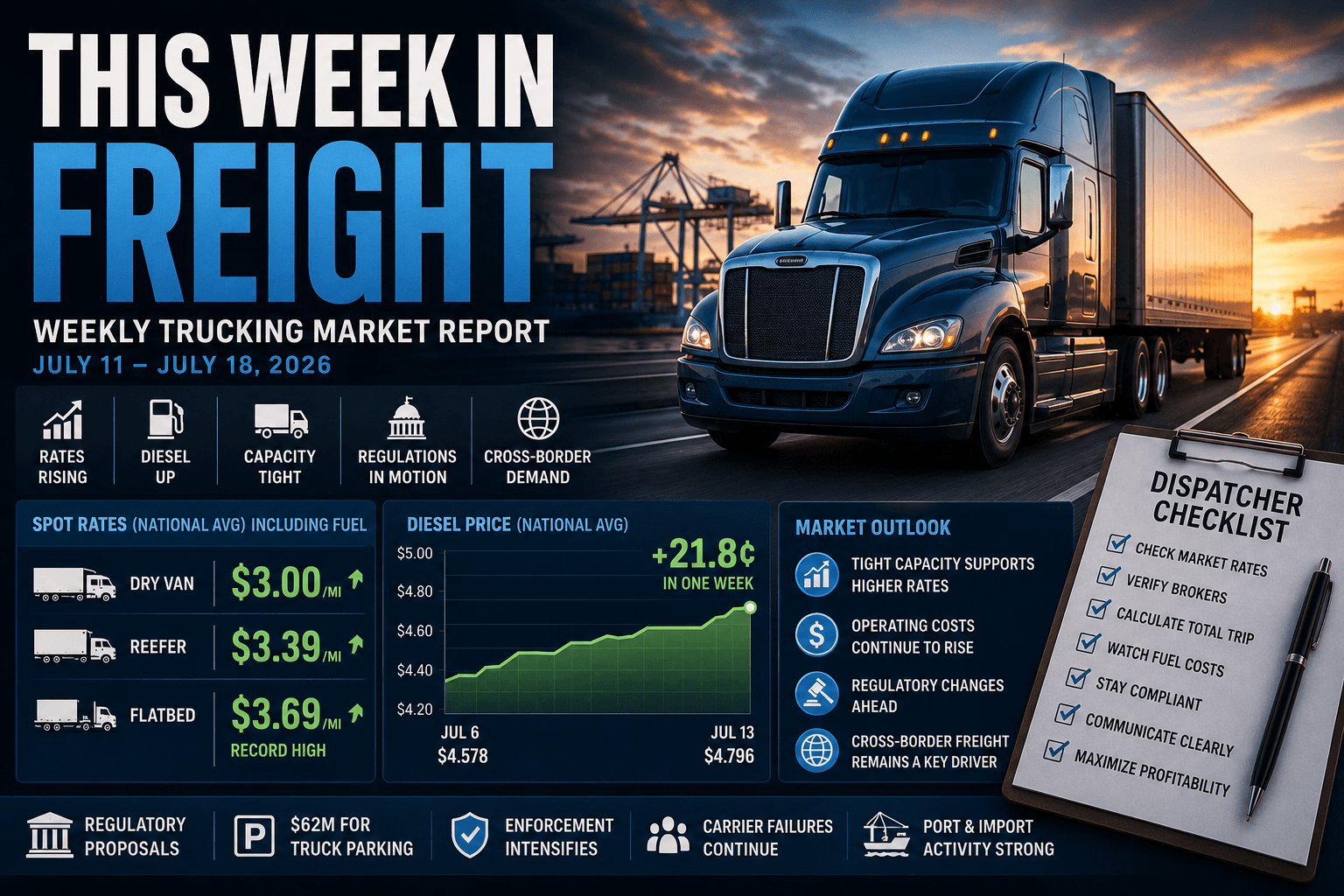
The freight market continued to strengthen this week, but the improvement is not being driven by a broad economic boom. Instead, the trucking industry is dealing with a combination of tighter capacity, fewer available drivers, rising operating expenses, elevated diesel prices and inconsistent freight demand.
This Week in Freight: Trucking Market Report for July 11–18, 2026
The freight market continued to strengthen this week, but the improvement is not being driven by a broad economic boom.
Instead, the trucking industry is dealing with a combination of tighter capacity, fewer available drivers, rising operating expenses, elevated diesel prices and inconsistent freight demand. These conditions are giving carriers more pricing leverage, particularly in the spot market, even though many trucking companies are still under financial pressure.
National dry van, refrigerated and flatbed spot rates remain significantly higher than they were a year ago. Industry rate indexes are expected to climb further during the third quarter, while diesel prices increased sharply during the week.
At the same time, several regulatory proposals and enforcement developments could affect drivers, carriers, brokers and dispatchers.
Here is what happened in freight during the week of July 11 through July 18, 2026.
Freight Market Summary
The major themes this week were:
Truckload capacity remains tight.
Spot rates are holding at strong levels.
Dry van spot rates have moved above contract rates.
Diesel increased by more than 21 cents per gallon.
Carrier operating costs continue to rise.
Truckload and LTL pricing could reach new highs in the third quarter.
Federal regulators are considering several major trucking rule changes.
Driver qualification and CDL standards remain under scrutiny.
Truck parking received a meaningful round of federal funding.
Carrier failures and logistics layoffs continue despite stronger rates.
Cross-border freight is becoming more important—and more complicated.
The freight market is improving from the carrier’s perspective, but higher revenue does not automatically mean higher profit. Fuel, insurance, labor, equipment, maintenance and regulatory costs are all consuming a larger portion of carrier revenue.
Truckload Spot Rates Remain Strong
The most important pricing development is that national dry van spot rates have moved above dry van contract rates.
DAT reported a national average dry van spot rate of approximately $3.00 per mile, including fuel, compared with an average contract rate of approximately $2.89 per mile. It was the first time the national van spot rate exceeded the contract rate since February 2022.
That inversion is important.
Contract rates typically sit above spot rates because shippers pay for committed capacity and predictable service. When spot rates overtake contract rates, it indicates that immediate truck capacity has become more expensive than previously negotiated transportation agreements.
It also suggests that some contract carriers may be rejecting or returning freight because they can earn more in the spot market.
Current national spot-rate benchmarks
The latest publicly reported DAT national averages were approximately:
Dry van: $3.00 per mile, including fuel
Reefer: $3.39 per mile, including fuel
Flatbed: $3.69 per mile, including fuel
The flatbed average represented a record, while reefer and van pricing also remained firmly elevated.
These are national averages, not guaranteed rates for every load. Actual pricing varies significantly based on origin, destination, equipment, pickup timing, commodity, appointment requirements, deadhead and local truck supply.
A dispatcher should never use the national average as the final rate for a lane. It should be treated as a market benchmark.
Dry Van Market: Capacity Is Tightening
Dry van pricing remains one of the clearest signs that the freight cycle has changed.
The national spot average has reached approximately $3.00 per mile including fuel, while DAT reported that dry van load-to-truck activity increased 9.6% during the week of July 6–12 compared with the previous week. June dry van load-to-truck activity was also 64% higher than June 2025.
This does not necessarily mean freight volume has increased by 64%. Load-to-truck ratios compare posted loads with available trucks, so the increase can reflect more freight, fewer available trucks or both.
The more likely explanation is a combination of seasonal demand and shrinking effective capacity.
C.H. Robinson reported that carrier supply has tightened across the North American truckload market, resulting in higher spot prices, weaker routing-guide performance and greater pressure on contract rates.
What dry van dispatchers should expect
Dispatchers should expect stronger negotiating conditions in tight outbound markets, but they should also prepare for significant regional differences.
Loads leaving major consumption, manufacturing and import markets may command stronger prices, while return freight into those markets may remain less attractive.
A strong outbound rate can still become an unprofitable round trip when the truck is delivered into a weak market.
Dispatchers should calculate:
Loaded rate per mile
Deadhead miles
Total trip miles
Expected reload rate
Time required at pickup and delivery
Fuel cost
Tolls
Driver hours remaining
Weekend or overnight exposure
The correct question is not simply, “What does this load pay?”
The correct question is, “What will this truck earn over the entire freight cycle?”
Reefer Market: Produce Demand Supports Rates
The national refrigerated spot rate remains around $3.39 per mile including fuel, according to recently reported DAT figures.
Summer produce movement continues to support refrigerated demand, although the market is shifting geographically as regional harvests move through their normal seasonal cycles.
Reefer carriers should pay close attention to produce-growing regions, food distribution hubs and markets with high grocery demand. However, reefer loads often involve longer wait times, stricter appointments and higher operational risk than dry van freight.
A dispatcher should confirm:
Required trailer temperature
Continuous-run or cycle-sentry instructions
Pre-cooling requirements
Pulp temperature requirements
Washout requirements
Lumper reimbursement
Detention terms
Rejected-product procedures
Temperature-record requirements
Claims instructions
Higher reefer rates do not eliminate the risks associated with food-grade and temperature-controlled freight. One rejected load or temperature claim can erase the profit from many successful trips.
Flatbed Market: Rates Reach Record Territory
Flatbed remains one of the strongest truckload segments.
The national flatbed spot rate has been reported at approximately $3.69 per mile including fuel, which DAT characterized as an all-time high.
Flatbed freight is benefiting from demand connected to manufacturing, industrial projects, utilities, infrastructure, energy development and data-center construction.
The market is not evenly strong everywhere. Construction activity has softened in some areas, while industrial and infrastructure-related freight remains more resilient.
Flatbed dispatchers must also account for operational requirements that are not captured by a basic rate-per-mile comparison:
Tarps
Chains and straps
Oversize permits
Escort requirements
Loading and unloading time
Job-site access
Weather exposure
Commodity-specific securement
Return opportunities
A $4-per-mile flatbed load that requires extensive tarping, long loading delays and a weak destination may be worse than a lower-paying load with faster loading and a strong reload market.
Truckload and LTL Rates Could Set New Highs in the Third Quarter
Industry pricing indexes increased during the second quarter, and analysts now expect truckload and less-than-truckload rates to reach new highs during the third quarter.
Several factors are contributing:
Carrier capacity has left the market.
Driver availability has tightened.
Equipment and insurance costs remain elevated.
Diesel remains expensive.
Enforcement and driver-qualification policies are reducing effective capacity.
Some shippers are moving freight early because of tariff uncertainty.
Manufacturing and industrial freight have provided pockets of demand.
These conditions give carriers greater leverage, but shippers are also becoming more selective about service reliability.
Carriers that communicate well, meet appointments and provide accurate paperwork may have more success securing repeat freight and improved contract terms.
Diesel Jumps More Than 21 Cents in One Week
Fuel was one of the week’s most important cost developments.
The national average price of on-highway diesel increased from $4.578 per gallon on July 6 to $4.796 on July 13, an increase of 21.8 cents per gallon in one week. Diesel was also $1.038 per gallon higher than it was one year earlier.
Regional increases were even larger:
Gulf Coast: up 32.1 cents to $4.546
Lower Atlantic: up 27.1 cents to $4.748
Midwest: up 20.1 cents to $4.659
East Coast: up 20 cents to $4.894
West Coast: up 12.5 cents to $5.550
California: up 5.3 cents to $6.126
These prices include taxes.
What the increase means for carriers
A truck averaging 6.5 miles per gallon and running 2,500 miles per week burns approximately 385 gallons.
A 21.8-cent increase adds roughly $84 per week in fuel expense for that truck, before considering idle time, reefer fuel or lower fuel efficiency.
Compared with the diesel price one year earlier, the same truck would be spending roughly $399 more per week on fuel.
That is why dispatchers need to separate the total rate from the linehaul rate and fuel surcharge whenever possible.
A headline rate can look attractive while producing a weak margin after fuel.
Carrier Operating Costs Continue to Rise
The American Transportation Research Institute’s annual operating-cost study found that trucking costs increased faster than general consumer inflation during 2025. The findings were reported this week as carriers entered another period of higher fuel, labor and equipment expenses.
This matters because carriers cannot judge market health solely by spot-rate increases.
Major expenses include:
Driver compensation
Diesel and diesel exhaust fluid
Truck and trailer payments
Maintenance and tires
Commercial insurance
Tolls and permits
Factoring
Compliance
Dispatching
Technology subscriptions
Claims and deductibles
Rates are improving, but many carriers are recovering from several years of weak margins. Some fleets are still operating with older equipment, delayed maintenance and damaged balance sheets.
Strong J.B. Hunt Results Support the Recovery Argument
J.B. Hunt reported second-quarter revenue of approximately $3.5 billion, an increase of 19% year over year, while earnings per share increased 45% to $1.91. Its intermodal volume increased 10%, and the company benefited from stronger service execution, equipment utilization and pricing trends.
The results were interpreted as another sign that freight conditions are improving.
However, one large carrier’s results do not prove that every trucking business is thriving. J.B. Hunt operates across intermodal, dedicated, truckload, brokerage and final mile, giving it advantages that small carriers do not have.
The broader takeaway is that freight pricing, utilization and intermodal demand are improving enough to benefit well-positioned transportation companies.
Freight Failures Have Not Ended
Despite stronger rates, trucking and logistics closures continued this week.
A freight-distress report published July 14 identified carrier, warehouse, intermodal and logistics closures affecting more than 245 jobs.
This is an important reminder that market recoveries do not rescue every company.
Businesses that accumulated heavy debt, lost customers, deferred maintenance or operated with poor cost controls during the downturn may still fail even as rates improve.
Small carriers should use stronger market conditions to repair their finances rather than immediately adding equipment.
That means:
Building a maintenance reserve
Paying down high-interest debt
Reviewing insurance coverage
Measuring profit by truck
Eliminating unprofitable lanes
Avoiding unnecessary equipment purchases
Maintaining cash for slow-paying customers
A stronger rate environment is an opportunity to improve the business—not permission to ignore costs.
FMCSA’s Regulatory Agenda Signals Major Changes Ahead
FMCSA released an ambitious regulatory agenda outlining several rulemaking priorities for the coming year. The agenda does not mean every proposal will become law immediately, but it identifies the issues federal regulators intend to address.
Important subjects include broker transparency, driver qualifications, safety technology, registration and compliance rules.
Broker transparency proposal
FMCSA is expected to move forward with a long-awaited proposal addressing broker transaction records and carrier access to brokerage information.
Federal broker regulations already require brokers to maintain transaction records and generally provide parties to the transaction with a right to review those records. The dispute centers on how that right should operate in modern brokerage contracts and electronic systems.
Carriers and owner-operator groups have argued that some brokers use contractual waivers to prevent carriers from reviewing transaction records. Broker groups have argued that mandatory disclosures could expose confidential commercial information and interfere with negotiated contracts.
Any proposed rule will likely generate significant debate.
For dispatchers and carriers, the practical issue is whether greater transparency would help them understand:
The amount paid by the shipper
The broker’s margin
Additional charges
Payment relationships
Whether a load was improperly re-brokered
A proposal is not the same as a final regulation. Carriers should watch the official notice and public-comment process before assuming that requirements have changed.
CDL standards and Dalilah’s Law
The Owner-Operator Independent Drivers Association urged the U.S. House of Representatives this week to vote on Dalilah’s Law following a fatal Pennsylvania crash. The proposed legislation would strengthen commercial driver licensing and verification standards.
The issue is part of a broader federal push toward stricter driver qualification, training, identity and English-language enforcement.
Any change affecting CDL eligibility could further reduce driver availability. That may improve rates through tighter capacity, but it could also increase labor costs and make it harder for carriers to seat trucks.
Passenger authorization proposal
The Commercial Vehicle Safety Alliance is advocating for a requirement that commercial drivers carrying passengers maintain written authorization in the truck. CVSA says documentation could help roadside inspectors distinguish authorized passengers from situations potentially involving human trafficking.
This is a proposal rather than an active nationwide requirement.
Carriers that allow spouses, family members or other passengers should already maintain a clear written passenger policy and confirm that their insurance permits passengers.
Automatic emergency braking rulemaking
The federal government is expected to resume work on a rule requiring automatic emergency braking systems on heavy vehicles. The rulemaking has faced delays and remains subject to additional agency action.
Potential effects include:
Higher new-truck equipment costs
Additional maintenance requirements
Questions about sensor performance
Possible safety and insurance benefits
New inspection and compliance procedures
Fleets should not treat the requirement as final until the agencies publish the applicable rule, implementation dates and equipment standards.
Federal Funding Provides $62 Million for Truck Parking
Federal BUILD grants announced this week included approximately $62 million for truck-parking improvements in five states. The trucking-related awards were part of $1.73 billion in transportation grants supporting 127 projects.
Truck parking is not simply a driver-convenience issue.
Insufficient parking can contribute to:
Hours-of-Service violations
Unsafe roadside parking
Lost driving time
Increased fuel use
Driver stress
Missed appointments
Reduced productivity
Additional parking can improve both safety and effective truck capacity by reducing the time drivers spend searching for a legal place to stop.
Enforcement Remained a Major Focus
Operation Safe Driver Week brought increased commercial vehicle enforcement in several states. Wisconsin continued its “Trooper in a Truck” program, while five Southern states focused on speeding and other unsafe driving behavior.
FMCSA also removed 10 electronic logging devices from its registered list on July 9. Carriers using the affected devices were given up to 60 days to replace them with compliant ELDs.
Carriers should verify that their ELD is still listed on FMCSA’s registered-device list. Using a revoked device after the replacement period can result in the driver being treated as operating without a compliant ELD.
Dispatchers should also avoid creating schedules that pressure drivers to speed, falsify logs or violate Hours-of-Service rules.
A good rate is not worth an out-of-service order, crash or nuclear verdict.
Cross-Border Freight Developments
Cross-border freight conditions remain divided.
C.H. Robinson reported tight capacity, border delays and firm pricing on Mexico-related routes, while Canadian freight demand remained softer amid uncertainty surrounding the future of the United States-Mexico-Canada Agreement.
The Gordie Howe International Bridge is also moving toward opening, providing another major freight connection between Detroit, Michigan, and Windsor, Ontario. The project is expected to strengthen U.S.-Canada freight capacity after years of construction and political delays.
In Mexico-related freight, dispatchers should account for:
Border wait times
Trailer interchange procedures
Customs documentation
Transfer-carrier arrangements
Cargo theft exposure
Mexican and U.S. holidays
Inspection delays
Insurance restrictions
A strong cross-border rate can quickly deteriorate when the truck or trailer sits at the border for an additional day.
Port and Import Freight Could Support Truck Demand
Importers have been frontloading freight ahead of tariff-related deadlines, and July container imports were projected to challenge previous records. This may support drayage, warehouse, intermodal and regional truckload activity near major ports and inland distribution hubs.
The Port of Savannah also completed a project intended to improve truck access and reduce congestion. The port remains especially important for Southeast freight, including Georgia, Florida, Alabama, Tennessee and the Carolinas.
Frontloaded imports can temporarily strengthen freight demand, but they may also pull freight forward from future months. Dispatchers should not assume that a strong July automatically guarantees equally strong import volume later in the year.
Technology Continues to Change Dispatching
Truckstop.com launched a voice-based carrier assistant intended to help drivers and carriers manage freight activity while on the road. BulkLoads also acquired Livestock Network, expanding its position in agricultural and livestock freight.
Several transportation technology companies are introducing tools that can:
Search for loads
Negotiate routine freight
Verify carriers
Analyze fuel use
Track equipment
Review compliance
Automate paperwork
Provide voice-based updates
Technology will not eliminate the need for skilled dispatchers. It will reduce the value of dispatchers who only perform repetitive data entry.
The most valuable dispatchers will be the ones who can interpret market conditions, negotiate difficult loads, protect carrier margins, manage relationships and solve problems that software cannot resolve on its own.
What Dispatchers Should Do Next Week
The freight market currently favors disciplined carriers and dispatchers.
Protect the stronger rate environment
Do not undercut the market simply to keep a truck moving. Check lane history, available truck capacity, fuel and reload conditions before quoting.
Calculate total-trip profitability
Include deadhead, tolls, fuel, detention exposure and the destination market. Revenue per loaded mile alone can be misleading.
Confirm diesel assumptions
Diesel increased sharply this week. Update fuel-cost assumptions rather than using an old number in profitability calculations.
Watch spot and contract relationships
Dry van spot rates moving above contract rates indicate tight immediate capacity. This may create negotiation opportunities, but conditions can vary by market.
Verify ELD compliance
Confirm that every carrier’s ELD remains on FMCSA’s registered list and replace any revoked device before the deadline.
Follow regulatory proposals carefully
Broker transparency, CDL standards, automatic emergency braking and passenger authorization remain developing issues. Separate proposed rules from final enforceable regulations.
Strengthen broker vetting
A stronger spot market can attract more double brokering, identity theft and fraudulent load activity. Verify the broker, email domain, rate confirmation, pickup number and payment record.
Build cash reserves
Use stronger rates to improve the carrier’s balance sheet. Higher revenue can disappear quickly through fuel, repairs, claims and insurance increases.
Freight Outlook for the Coming Week
The immediate outlook remains favorable for truckload pricing but challenging for operating margins.
Capacity appears tight enough to support elevated spot rates. Import frontloading, produce freight, industrial projects and seasonal demand should continue creating opportunities in selected markets.
However, dispatchers should monitor four risks:
Diesel volatility: Another large increase would quickly reduce carrier margins.
Post-holiday normalization: Some spot-market strength may ease as networks recover from seasonal disruption.
Uneven demand: Freight is not equally strong across every region or equipment type.
Frontloaded imports: Early shipping may weaken demand later if freight has merely been pulled forward.
The market is stronger, but this is not a return to easy money.
Carriers that understand their costs, maintain equipment, control deadhead and negotiate strategically are positioned to benefit. Carriers that chase headline rates without understanding the full trip can still lose money.
Final Takeaway
The trucking market continued to tighten during the week of July 11–18, 2026.
National spot rates remain elevated, dry van spot pricing has moved above contract pricing, flatbed rates are in record territory and industry analysts expect truckload and LTL pricing indexes to climb further during the third quarter.
At the same time, diesel increased by more than 21 cents per gallon in one week, carrier expenses continue to outpace inflation and freight-business failures have not stopped.
Regulatory activity is also accelerating. Broker transparency, CDL qualifications, passenger authorization, automatic emergency braking, ELD compliance and commercial vehicle enforcement are all issues carriers and dispatchers should monitor.
The opportunity is real, but so is the risk.
This is a market that rewards dispatchers who understand costs, study lanes, verify brokers, communicate clearly and look beyond the advertised rate.
Frequently Asked Questions
- What happened in the trucking industry this week?
- This week saw stronger national spot rates, tighter truck capacity, higher diesel prices, continued carrier operating cost pressures, new FMCSA regulatory proposals, increased commercial vehicle enforcement, and ongoing investment in truck parking infrastructure. Dispatchers should also monitor developments related to broker transparency, CDL standards, and cross-border freight.
- Are freight spot rates increasing?
- Yes. National spot rates remained elevated throughout the week. Dry van spot rates continued to outperform many contract rates, while refrigerated and flatbed freight also remained strong. Actual rates still vary by lane, equipment type, freight demand, and regional truck availability.
- Why are diesel prices important for dispatchers?
- Fuel is one of the largest operating expenses for carriers. Even small increases in diesel prices can significantly reduce profit margins on long-haul loads. Dispatchers should consider fuel costs, deadhead miles, tolls, and expected reload opportunities when evaluating a load—not just the advertised rate per mile.
- What should truck dispatchers focus on next week?
- Dispatchers should closely monitor freight demand, negotiate rates based on current market conditions, verify new brokers before booking loads, track diesel prices, calculate total trip profitability, stay informed about FMCSA regulatory developments, and position trucks in stronger outbound freight markets to maximize revenue.